
How the Grant Readiness Assessment Works
Plain-language explanation of how your compliance score is calculated, how recommendations are selected, and what your results mean.
Who Designed This Assessment
The Grant Readiness Assessment was designed by the founding team at JS Grants & Compliance Consulting LLC, based on hands-on grants management experience working directly with 2 CFR Part 200 (Uniform Guidance) requirements, built from the practitioner's perspective, not from the outside looking in.
The assessment framework (the compliance domains, question logic, scoring criteria, flag detection rules, archetype patterns, and regulatory interpretations) is JSGC's core intellectual property. It is grounded in real-world federal grant compliance experience, not generic best-practice templates.
How Your Score Is Calculated
Your Grant Readiness Score (0–100) is calculated by JSGC's deterministic scoring algorithms. No AI model is involved in scoring. Your answers are evaluated against seven compliance domains, weighted by relative compliance impact:
- Organizational Infrastructure & Governance12%
Policies, registrations, staffing, governance documentation, and the foundational infrastructure needed to administer federal awards responsibly.
- Financial Management & Internal Controls22%
Accounting systems, internal controls, segregation of duties, cost allocation, and financial recordkeeping practices required under 2 CFR 200.302-200.309.
- Procurement & Contracting20%
Procurement standards, conflict of interest policies, contractor selection methods, micro-purchase thresholds, and documented procedures required under 2 CFR 200.317-200.327.
- Award Management & Reporting13%
Grant tracking, reporting timelines, budget monitoring, and compliance with award terms and conditions under 2 CFR 200.308-200.344.
- Subrecipient Monitoring12%
Pass-through entity responsibilities, subrecipient risk assessments, monitoring plans, and compliance oversight required under 2 CFR 200.332.
- Audit Readiness & Findings Resolution12%
Single Audit preparedness, SEFA maintenance, corrective action plans, prior findings resolution, and documentation practices for organizations expending federal awards.
- Data Security & Technology Controls9%
Information security policies, access controls, data protection practices, and technology safeguards for federal grant data under 2 CFR 200.303(e).
Section weights adjust based on your organization profile. Subrecipient Monitoring activates only for pass-through entities; when inactive, its weight is redistributed proportionally across the remaining sections. Additional context multipliers apply based on award portfolio size and organizational complexity.
Tier Classification
Your overall score determines your compliance readiness tier, applied by rule-based thresholds:
- Audit-Ready: Strong controls across all domains; minor improvements may still be warranted.
- Developing: Solid foundation with identifiable gaps; targeted remediation recommended.
- At Risk: Significant compliance gaps across multiple domains; structured improvement plan needed.
- Critical Gaps: Fundamental control weaknesses; immediate attention required before accepting new awards.
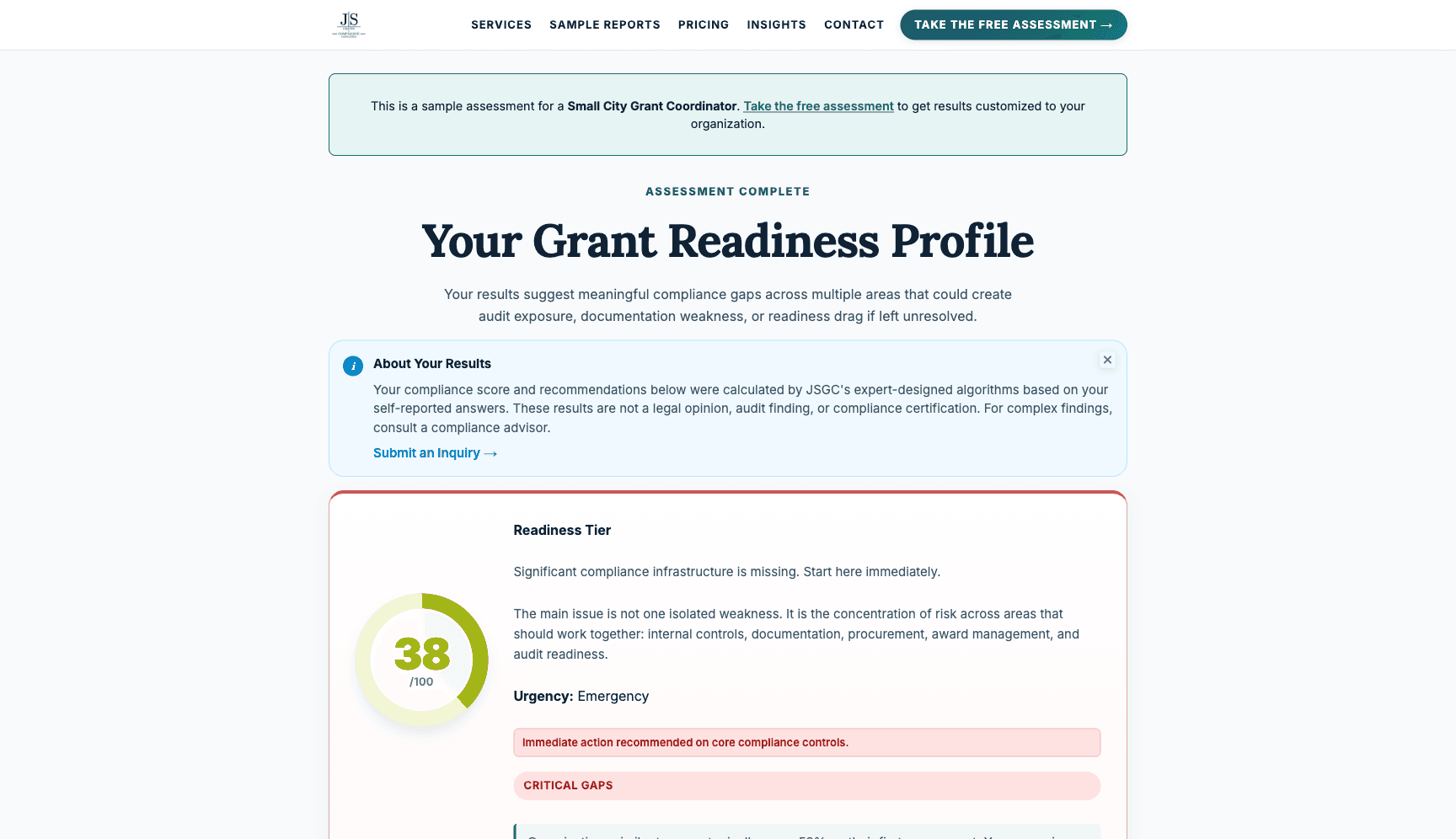
BetaSample assessment results for a small city. View full sample reports.
How Recommendations Are Selected
Product recommendations are selected by a rule-based recommendation engine. Again, no AI model involved. The engine maps your compliance score patterns, detected gaps, and organization profile to a curated catalog of JSGC's advisory products and training resources, calibrated to what will actually move the needle for your specific situation.
Compliance flags (specific risk indicators) are derived directly from your answers by a deterministic mapping table. Archetype detection (e.g., “Policy Paper Tiger,” meaning strong written policies but weak implementation evidence) is identified by cross-answer pattern matching. Neither uses AI.
Plain-Language Executive Summary
Your results include a plain-language summary of your compliance posture (a short overview, risk framing, and prioritized next steps) generated by JSGC's deterministic content engine from your score data.
What This Assessment Is Not
Regardless of your score, this assessment:
- It is not legal advice and cannot substitute for a qualified attorney or CPA on compliance matters.
- It is not an audit, attestation, or review under GAGAS, the Single Audit Act, or any other professional auditing standard.
- Completing the assessment and implementing recommendations does not guarantee audit-clean opinions or full compliance with all applicable requirements.
- Results are based solely on your self-reported answers. We do not review your actual financial records, written policies, award documents, or supporting documentation.
- Program-specific requirements (DOJ, HUD, BSCC-administered awards, etc.) may differ significantly from the general 2 CFR Part 200 framework assessed here.
- Organizations with high-priority findings should consult a qualified compliance professional before making significant compliance decisions based solely on this report.
Your Data and Privacy
What we store: Your assessment answers and generated report are stored securely in JSGC's database (Supabase, hosted in the United States) and linked to your account email when you choose to provide it. Assessment data is retained per our standard data retention schedule and may be deleted upon request.
JS Grants & Compliance Consulting LLC is an independent advisory firm. This assessment and its outputs are not legal advice, audit opinions, or CPA services. We do not represent clients before federal agencies or provide attorney–client services.
Questions about your results or this methodology? Contact us →